
Gibreel’s War Between Love and Judgment
The Satanic VersesThis conflict traces Gibreel Farishta’s growing belief that he is an angel with a divine mission, as that belief collides with love, doubt, and the harm he causes.
increasing Bearing strength in each event
 decreasing
Bearing strength in each eventdecreasingSleep Becomes a Threat
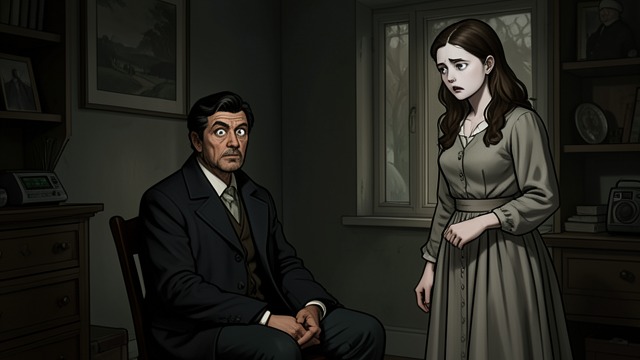
The Dreams Take Command
An interrupted life
While the hijacked passengers wait for a decision about their fate, Gibreel increasingly resists sleep. His dreams resume where they left off, placing him inside visions of the Prophet and an archangel whose actions seem bound to Gibreel’s own body and voice.
Two explanations compete
Gibreel believes that he may be experiencing a divine reality rather than an ordinary nightmare; Saladin dismisses that possibility as madness. Gibreel’s conviction does not bring calm. The repeated dreams make sleep itself seem like a threat and intensify his fear that another self is taking control.
The conflict begins as a struggle over interpretation: is Gibreel dreaming of an angel, or becoming the figure he dreams? His inability to settle the question turns private uncertainty into an ongoing crisis.
The Angel Takes Over

Revelation Without Restraint
London as a mission field
Gibreel’s visions expand from the Prophet’s story to the exile and revolution of the Imam. He comes to believe that he has been chosen to act as an archangel and to remake London, replacing its moral ambiguity with the sharp distinctions he associates with divine truth.
Love becomes an obstacle
When Gibreel sees Alleluia Cone’s concern as evidence that she doubts him, he interprets their separation as a test of his religious purpose. He leaves her and roams the city convinced that he must identify and defeat evil, even as the boundary between dream and waking life continues to fail.
The conflict is increasingly self-reinforcing: each painful human relationship becomes evidence for the angelic story, and each apparent revelation authorizes another rejection of ordinary obligations.
The Failed Tropicalization
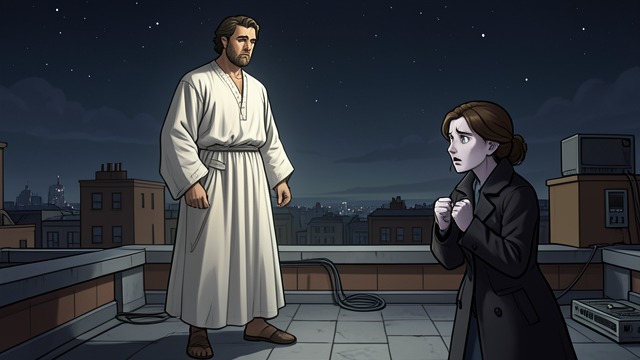
A Vision Becomes a Plan
The city must change
At Earls Court, Gibreel interprets the crowd’s response through his growing angelic certainty. He disappears from the stage and believes himself to be flying above London, where he declares that the city’s climate and character must be transformed.
The transformation collapses
Gibreel attempts to tropicalize London, imagining that heat will produce moral clarity and a more expressive public life. His vision ends with him collapsing at Alleluia’s doorstep and confessing that the experience has happened again. His mission does not make him master of the city; it demonstrates how little control he has over the visions he treats as commands.
The episode sharpens the conflict between Gibreel’s belief in his special power and his dependence on other people’s care. The more he claims to act for humanity, the more the consequences return to the intimate world he is trying to escape.
The Trumpet and the Riot
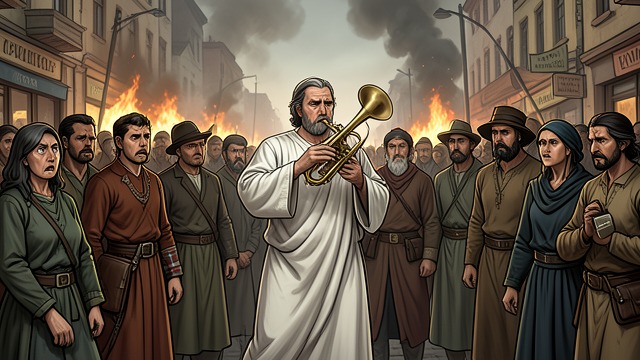
Judgment in the Burning City
A widening crisis
As anger over Uhuru Simba’s death and racialized policing spreads through Brickhall, Gibreel walks the streets believing he must answer the city’s suffering. He carries a trumpet he calls Azraeel and interprets his encounters as signs that divine judgment is expected of him.
The weapon is used
Gibreel blows the trumpet against the pimps who prey on young girls. He then moves through the riot, treating the fires as the fulfilment of people’s desires and describing the destruction as judgment. His actions fuse compassion for the exploited with a terrifying certainty that he may decide who must burn.
The conflict reaches a dangerous point: Gibreel can recognize real suffering, yet his chosen response converts rescue into punishment on a vast scale. His claim to be an instrument of justice makes it harder to distinguish protection from vengeance.
The Killing and the Final Choice
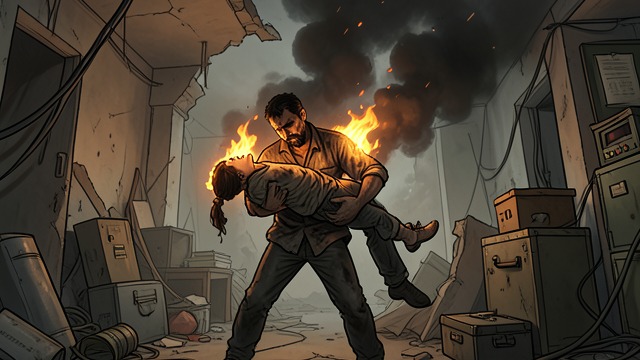
A Last Confrontation
Recognition amid the flames
During the Shaandaar fire, Gibreel discovers that Saladin has manipulated him through the anonymous voices that fed his jealousy and madness. He recognizes the harm Saladin caused but also sees that his adversary is a human being rather than a supernatural enemy.
Violence turned inward
Gibreel carries Saladin out of the burning building, choosing rescue over retaliation. Later, after Alleluia Cone’s death and his own return to Bombay, he confesses that he killed S. S. Sisodia and helped cause her fatal fall. When the police arrive, he uses the gun hidden in the lamp to shoot himself.
The two decisions give the conflict its final shape: Gibreel can act mercifully toward Saladin, but cannot live with the recurring sickness, guilt, and delusion. The ending does not reconcile divine judgment with human responsibility; it leaves his last acts as both a rescue and an irrevocable self-destruction.
During the 111-day hostage crisis aboard the Bostan
After Gibreel reaches London and his visions begin to enter waking life
After Gibreel returns to the stage at Earls Court
During the Brickhall riots, after Uhuru Simba dies in custody
At the Shaandaar fire and later in Changez’s study in Bombay
